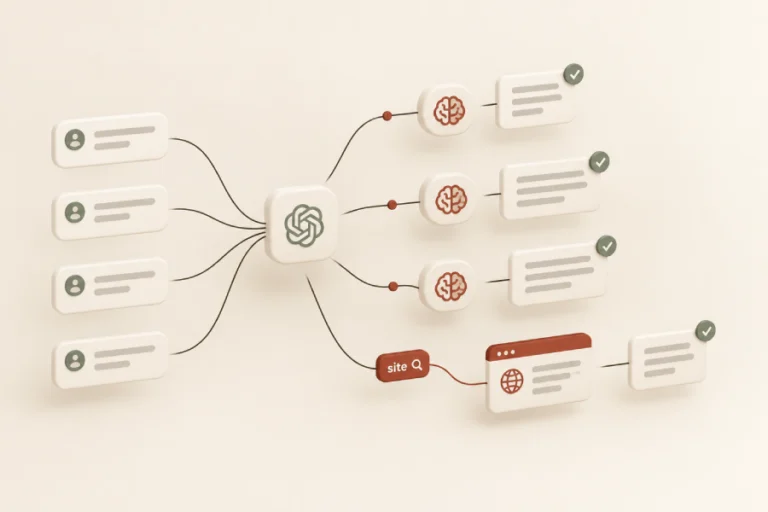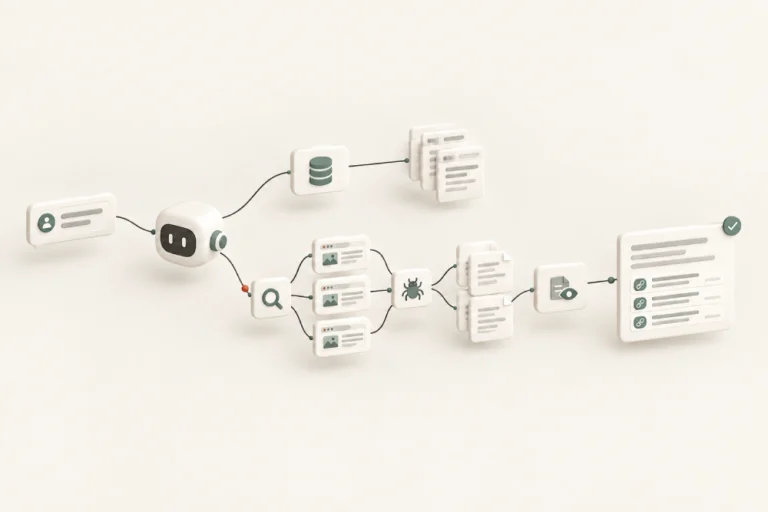


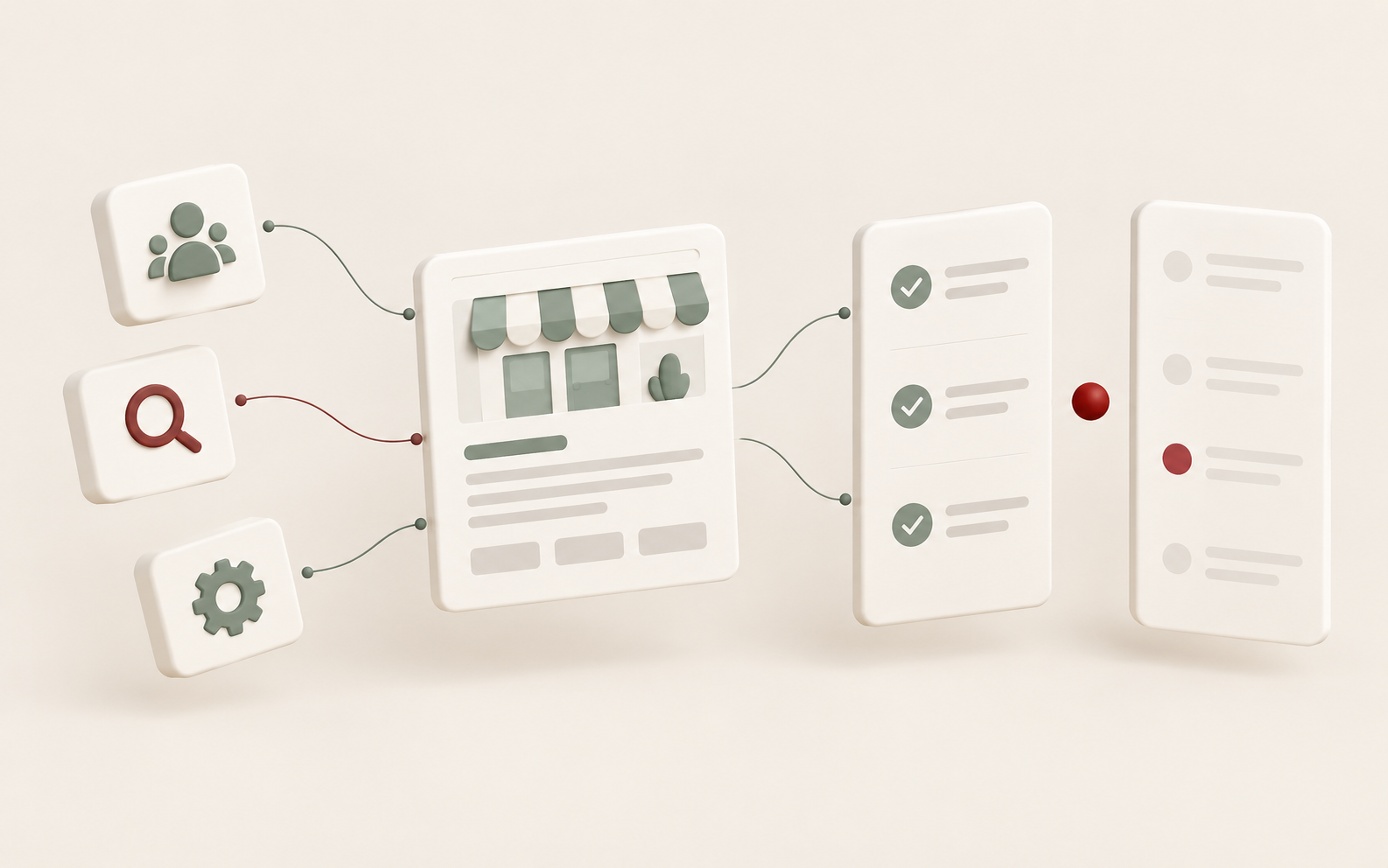
AI visibility is three separate things, not one. Whether an AI engine knows your business by name, whether it finds you when someone describes what you sell, and whether it recommends you on a shortlist are three different results with three different causes. Two of the three can be measured for free, today, with data you already own. The third cannot be measured by anyone.
The short version:
- I ran 75 prompts across ChatGPT, Claude and Google’s AI Mode on three real businesses on 13 September 2026
- Known by name: 73% · found by category: 18% · recommended on a shortlist: 0%
- Google Search Console has reported AI-feature impressions for every site worldwide since 31 August 2026 — impressions only, no clicks, no queries
- Google Analytics 4 has an AI Assistant channel that excludes Google’s own AI features by design
- One business recorded 18,231 AI impressions and was recommended zero times
- Nobody can tell you how often ChatGPT or Claude showed your business, and no tool that says otherwise is measuring what it claims
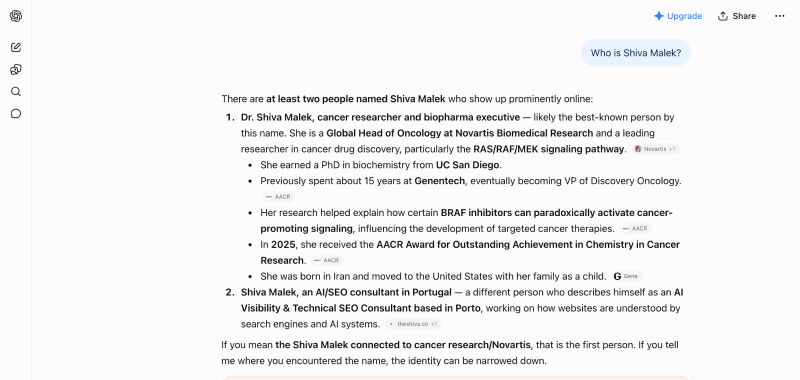
What does “AI visibility” actually mean?
AI visibility means whether AI answer systems name your business, link to it and describe it correctly when someone asks a question your business should win. The term is sold as a single score, but it covers three distinct results that move independently of each other:
- Known by name — the engine can describe your business when asked about it directly
- Found by category — the engine returns you when someone describes what you sell, without knowing you exist
- Recommended on a shortlist — the engine puts you in the answer to “who should I hire” or “recommend three”
A business can be excellent at the first and absent from the third, and most are. The distinction matters because each of the three is worth a different amount of money, and each is won by entirely different work.
Being known, being found, and being recommended are three different results
| Question type | What the buyer types | What a result is worth |
|---|---|---|
| Name | “What is [your business]?” | Almost nothing on its own. The person already knows you |
| Category | “employment lawyer”, “private food tour” | A stranger arrives who had never heard of you |
| Shortlist | “recommend three”, “who is best”, “book me one” | The purchase. This is the answer that replaces the decision |
Every AI visibility score I have seen reports these three as one number. The data below is what happens when you separate them.
What can you measure for free, and what can nobody measure?
Two free first-party sources exist, and most published advice still does not mention either one. Google Search Console reports how often your pages appeared inside Google’s AI features. Google Analytics 4 reports how many people arrived from AI assistants. Neither source reports what the other reports, and no calculation reconciles them.
| Search Console, generative AI report | Analytics 4, AI Assistant channel | |
|---|---|---|
| Covers | AI Overviews and AI Mode | ChatGPT, Gemini, Copilot and similar |
| Reports | Impressions | Sessions, engagement, key events |
| Proves | You appeared | Someone arrived |
| Cannot tell you | Clicks, click-through rate, position, which question | How often you appeared, or in how many answers |
| Cost | Free | Free |
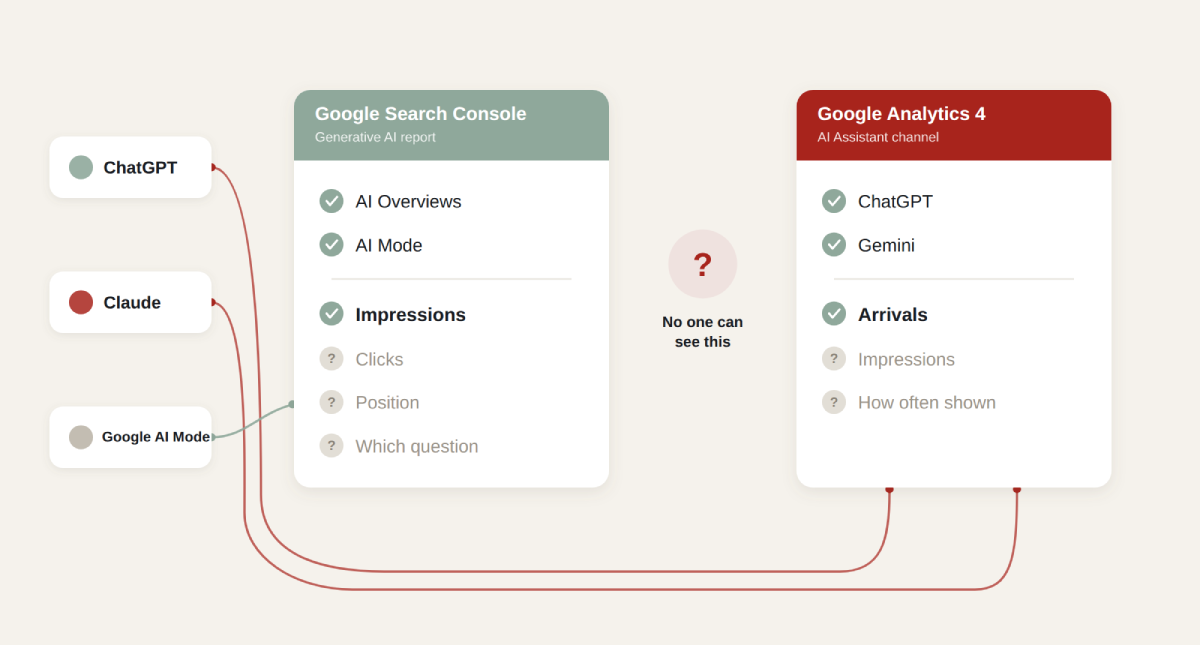
Google’s AI features: appearance without clicks
Search Console’s generative AI performance report shows how many times links to your site were shown inside AI Overviews and AI Mode. Google announced the report on 3 June 2026 and its help page for the generative AI performance report states that the rollout reached all websites worldwide on 31 August 2026. The report carries four dimensions — pages, countries, devices and dates — and a single metric, impressions.
There is no query dimension in that report, which is the part worth sitting with. You can see which of your pages appeared inside an AI answer. You cannot see what was asked.
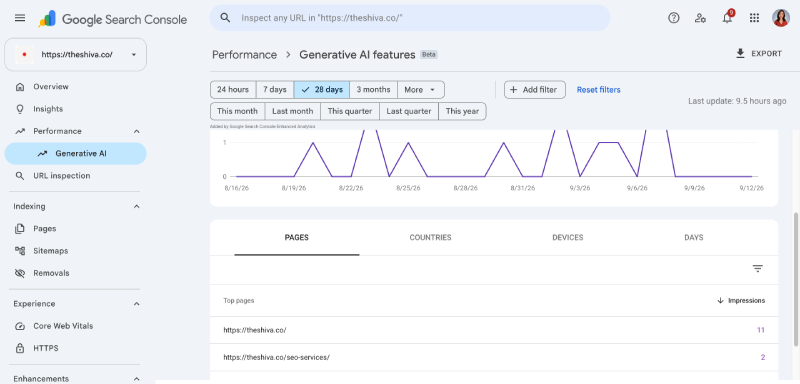
The assistants: arrivals without appearance
Google Analytics 4 now carries a default channel group called AI Assistant, which Google defines as arrivals “from sources like ChatGPT, Gemini, Deepseek, Copilot, or Grok”. The same default channel group documentation states that the AI Assistant channel excludes Google’s AI Overviews and AI Mode, and that Organic Search includes them.
Anyone reporting “our AI traffic” from a custom channel built on assistant hostnames is therefore reporting a figure with Google’s own AI surfaces removed from it, sitting unnoticed inside Organic Search.
Why the two numbers cannot be added together
Google’s AI surfaces give you appearance and never clicks. The AI assistants give you arrivals and never appearance. No single number contains both, and any product that presents one is combining a measured thing with an estimated thing and calling the result a metric.
Google’s own guidance page for site owners, AI features and your website, still directs readers only to the main performance report and carries a last-updated date of 10 December 2025 — nine months before the dedicated report reached every site. Most published advice was written from that page, which is why most published advice is missing half of what is now available.
What happened when I asked AI about three real businesses?
I ran 75 prompts across ChatGPT, Claude and Google’s AI Mode on 13 September 2026, against three businesses at three different stages of work. The businesses were named in 18 of the 75 answers. Split by question type, the pattern is stark: 73% by name, 18% by category, and zero on a shortlist.
The method, in enough detail to copy
Ten prompts per business, in three tiers — two by name, five by category, three shortlist. Each prompt was run once, in a new chat, signed out, on the same day. No answer was re-rolled. Where an engine gave a disappointing answer, that answer is the result.
Two of the three businesses are client sites, so I am publishing the counts in full and withholding the prompts, the screenshots and anything identifying. The third business is mine and every screenshot in this article is from my own results.
The three businesses
| Business | Stage of work |
|---|---|
| theshiva.co — mine | Live under one month. No blog, no backlinks, nothing published |
| A professional services firm | Over 200 pages, two decades of reputation. Audited, nothing implemented yet |
| A private tour operator | Nine months of technical SEO and content work completed |
What the numbers say
| Question type | Answers | Business named | Rate |
|---|---|---|---|
| Name — “What is X?” | 15 | 11 | 73% |
| Category — “employment lawyer” | 39 | 7 | 18% |
| Shortlist — “recommend three” | 21 | 0 | 0% |
| All | 75 | 18 | 24% |
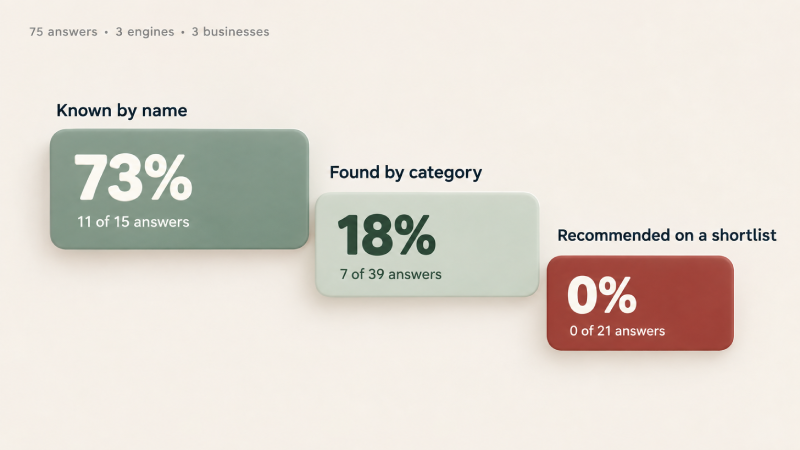
Three real businesses, three engines, 21 attempts at the question a buyer asks immediately before spending money, and not one of the three was named once.
| Business | ChatGPT | Claude | Google’s AI Mode |
|---|---|---|---|
| theshiva.co | 3 / 10 | 0 / 10 | 1 / 10 |
| Professional services firm | 2 / 5 | 0 / 5 | 1 / 5 |
| Tour operator | 6 / 10 | 3 / 10 | 2 / 10 |
| Total | 11 / 25 | 3 / 25 | 4 / 25 |
A single AI visibility score would have to average 44% and 12% into one figure and hand it to a business owner as though it described something.
Why does the same question get three different answers?
ChatGPT, Claude and Google’s AI Mode run separate crawlers, separate retrieval systems and separate models, so the three produce answers with almost nothing in common. Asked the same category question about the professional services firm on the same day, one engine listed the firm first, one omitted it entirely, and one did not search the web at all.
| Engine | Result for one category question | What it cited |
|---|---|---|
| ChatGPT | Listed the firm first | The firm’s own website, plus six competitors’ own sites |
| Claude | Did not search the web | Nothing. Advised contacting a professional body |
| Google’s AI Mode | Seven firms, client absent | An industry directory, plus firms’ own sites |
The divergence is sharper on superlative questions. Asked which were the best firms in the client’s field, ChatGPT named six and Claude named four, and not one firm appeared on both lists. Two engines, one question, one day, zero overlap.
Anyone selling a single AI visibility score has to reconcile that divergence somehow, and the only way to reconcile it is to average it away.
Who actually gets cited in AI answers?
Four different kinds of source hold the citation slots in AI answers, and your own website is only one of them. Across the 75 answers, the pattern held consistently: the shape of the question decided where the answer came from, and only one of the four shapes was answered from businesses’ own pages.
| Question shape | Who holds the citation slots | Can website work win it? |
|---|---|---|
| “best” or “top” professional services | Industry ranking directories | No. Needs a directory listing |
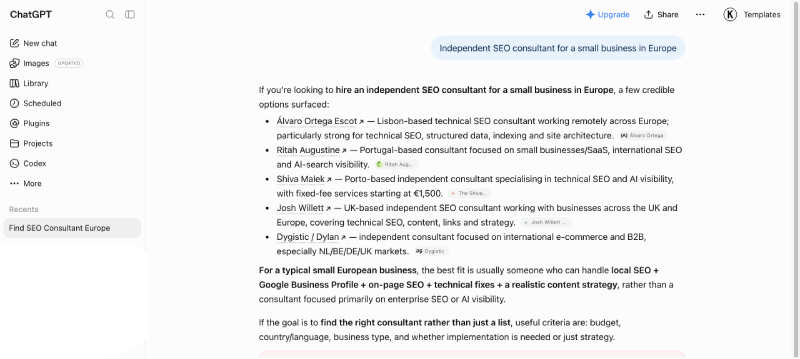
| “recommend three” local services | Google Business Profiles — map pins, star ratings, “Google” as the cited source | No. Needs profile and review work |
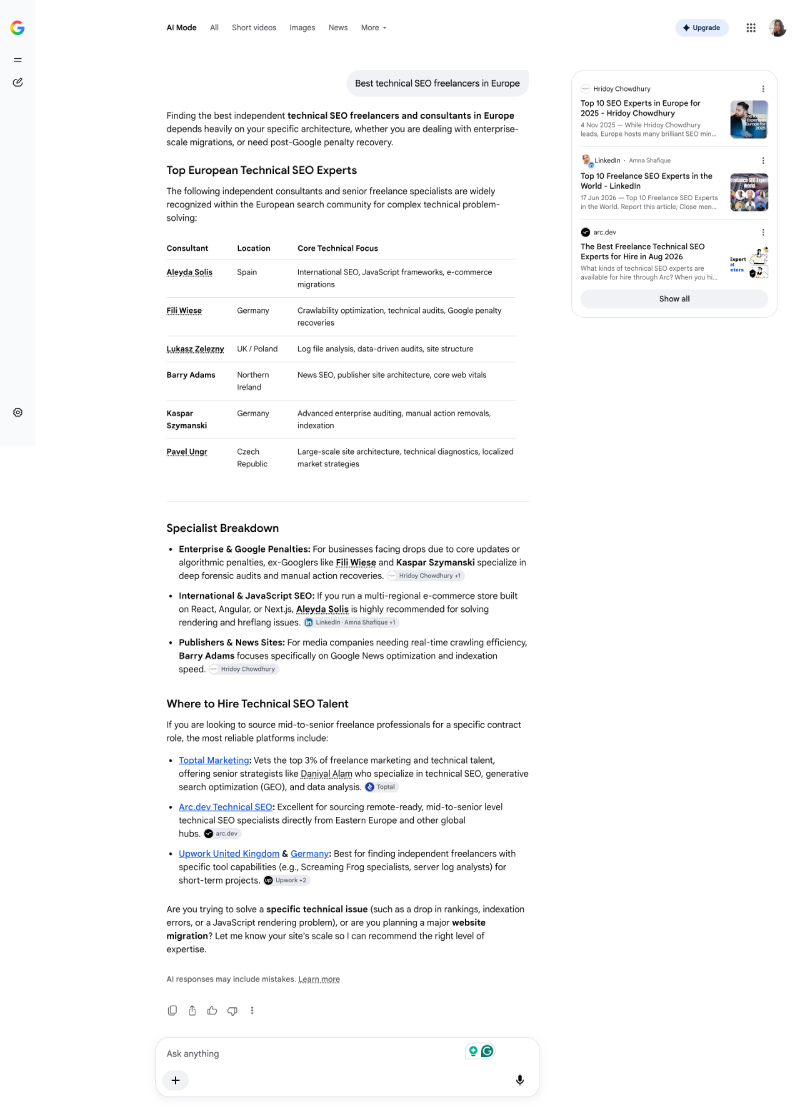
| “best freelancers” or “best consultants” | Third-party listicles and social posts | No. Needs someone else to list you |
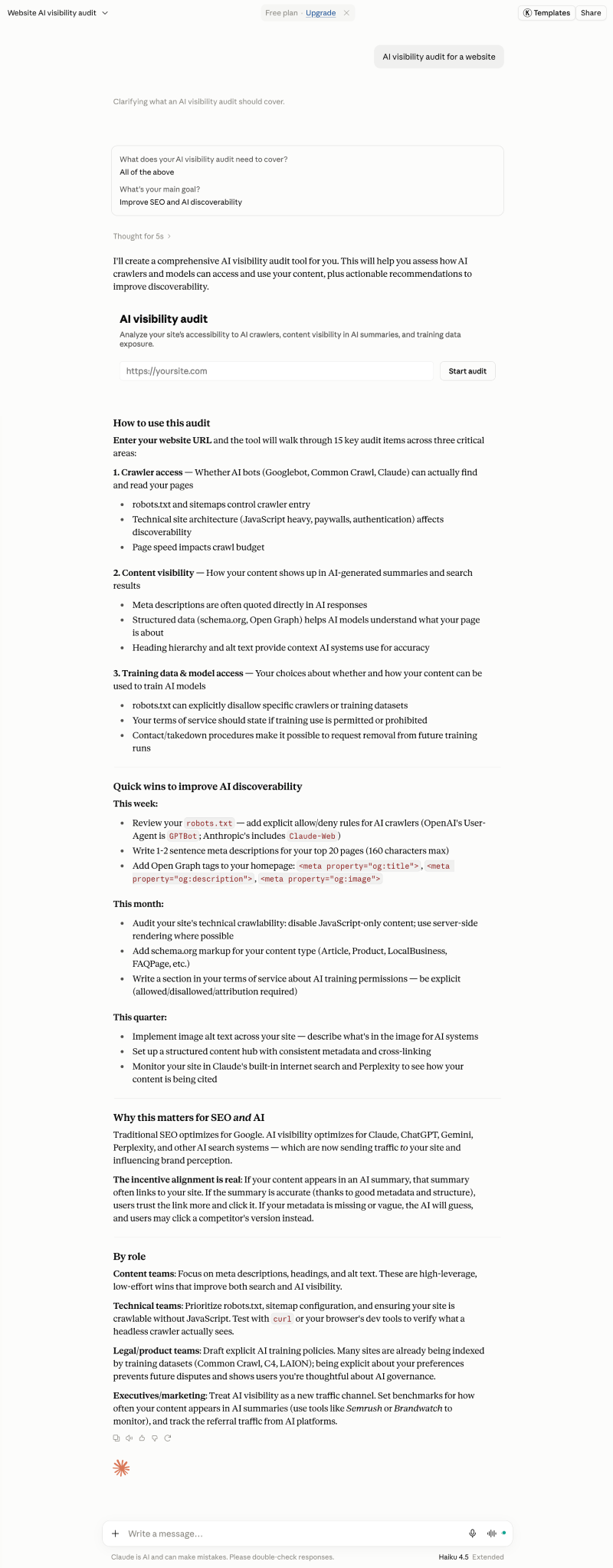
| A specific need, described in detail | Businesses’ own websites | Yes |
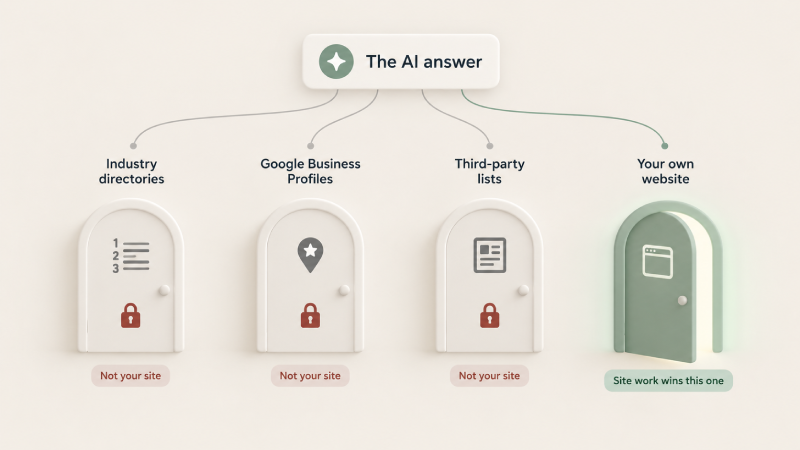
The three slots your website cannot reach
Industry directories dominate professional-services answers. In one Google AI Mode answer the text said so outright, naming the two directories it had drawn on as the authority on which firms rank highest. No amount of work on a firm’s own site places it in a directory it is not listed in.
Google Business Profiles dominate local shortlist answers. Asked to recommend three operators in a city, Google’s AI Mode returned three business profiles with star ratings and a map, citing Google itself as the source. ChatGPT showed the same profile data, ratings and opening hours inside its own answer.
Third-party lists dominate consultant and freelancer answers. Asked for the best technical SEO freelancers in Europe, Google’s AI Mode built its answer from one author’s top-ten article and a post on LinkedIn, and named six people. I was not one of them, and no change to my own website would have made me one.
The one slot your website can win
Specific-need questions are answered from businesses’ own pages. When the question described a situation rather than asking for a ranking — a particular kind of dispute, a particular kind of visitor, a particular constraint — the engines cited businesses’ own service pages and named smaller firms alongside large ones. That is the tier structured data, clear service descriptions and extractable page copy actually move.
Can a business appear thousands of times in AI and still never be recommended?
Yes, and one of the three businesses is the proof. Over 16 months its pages were shown 18,231 times inside Google’s AI features, while across the same week the three engines named it in zero of nine shortlist answers. Both figures are accurate. They describe different things.
The page-level breakdown explains how both can be true at once.
| Page type | Share of AI impressions |
|---|---|
| A single editorial article on the history of the subject | 57% |
| The top five pages, all editorial | 79% |
| Every page that takes a booking, combined | 12.5% |
| The home page | 1.4% |
The tour operator is winning the encyclopaedia question and losing the buying question. Its best-performing educational article outperforms its best-performing sales page by roughly 24 to 1 inside Google’s AI features, and no single score can express that, because the two results move in opposite directions.
Nine months of technical work produced that presence. The work did what it was aimed at — the business is known by name on every engine tested, described accurately, and picking up real volume. The shortlist gap is a different mechanism, held by Google Business Profiles and booking platforms, and a website cannot reach it. Knowing which of the two you are looking at is the entire value of measuring properly.
Why does testing your own brand give a flattering answer?
Two things corrupt a self-run test, and both appeared in my own data. The engine may know who is asking, and the engine may not search the web at all. Either one produces a result that says more about the test than about the business.
The engine may know who is asking
One of the accounts I tested from carried memory of my consulting work, and ChatGPT said so in the answer. Asked for the best operators in a category, the reply included a line to the effect of: “Since you’ve been researching [the business] for your own work, I wouldn’t automatically dismiss it.”
ChatGPT was stating in plain text that it raised a business because of who was asking. A business owner typing their own brand name into an account that knows them will see a flattering answer and believe the market sees the same one.
Test signed out, in a private window, every time. No exceptions, including for the run you only meant as a quick check.
The engine may not search the web at all
Retrieval is not guaranteed. Claude answered one category question by searching the web and returning five named firms with citations on 2 September 2026, then answered the identical question eleven days later without searching, from memory, naming nobody relevant. Same prompt, same engine, opposite behaviour. Why an engine sometimes answers from memory, and what that means for which pages can be cited, is the subject of how AI engines actually find, read and cite a website.
A tracking tool sampling on the second date would have recorded a zero for every business in that category, for a reason that has nothing to do with any of their websites.
What is an “AI visibility score” actually measuring?
An AI visibility score measures a sample of prompts the vendor chose, run on a schedule the vendor chose. That is a real measurement of a real thing, and it is not the same thing as either free source. A score measures simulated demand. Search Console measures observed appearance. Analytics measures observed arrival.
| Number | What it observes | Where it comes from | What it cannot say |
|---|---|---|---|
| AI impressions | Appearance | Google Search Console | Whether anyone clicked, or what was asked |
| AI Assistant sessions | Arrival | Google Analytics 4 | How often you appeared |
| AI visibility score | Simulated demand | A vendor’s prompt panel | Whether real people ask those questions |
The useful question to ask a vendor is not whether the score is accurate. It is which prompts are in the panel, how often they run, and what the engines were asked to do. A vendor who will answer those three questions is selling you a measurement. One who will not is selling you a number.
What can none of this tell you?
The method in this article has hard limits, and naming them is part of using it honestly. Five things about AI visibility cannot be known by me, by you or by any tool currently on sale — not because the tools are bad, but because the engines do not publish the data, and two of the five are unknowable in principle rather than merely unavailable today.
- How often ChatGPT or Claude showed your business. OpenAI and Anthropic publish no impressions data for websites, and none has been announced
- Which questions you appeared for in Google’s AI features. Search Console’s generative AI report has no query dimension
- Whether one test represents the average. A prompt run is a sample of one moment, and answers move between runs
- Whether appearing led to anything. Appearing is not being chosen, and being cited is not being clicked
- Whether any change will produce a citation. Nobody can guarantee one, and the four citation regimes above are the mechanism explaining why
Every one of those limits is a reason to measure what can be measured rather than to buy a number that papers over them.
How do you run this on your own business?
Three steps, about an afternoon, and no budget. Pull the two free reports, run ten prompts across the three engines, then read which sources the answers came from rather than reading a score. The third step is the one that tells you something no tool will.
Step one: the two free reports, in twenty minutes
- Open Google Search Console, go to the generative AI performance report, set the range to 16 months and export by page. Note which pages appear and which do not
- Open the main performance report for the same range and note total impressions, so you can express AI impressions as a share of the total
- Open Google Analytics 4, add Session default channel group to your acquisition report, and read the AI Assistant row for sessions and engagement
- Do not calculate a click-through rate for AI features. There are no clicks in that report, and writing down that you cannot is half the exercise
Step two: ten prompts, three engines, one afternoon
Write ten prompts in the three tiers — two by name, five by category, three shortlist — phrased the way a customer would phrase them rather than the way you would. Run each once, signed out, in a new chat, across ChatGPT, Claude and Google’s AI Mode. Screenshot every answer. Do not re-run an answer you dislike, because that answer is your result.
Step three: read the sources, not the score
| Record this | Because it tells you |
|---|---|
| Was the business named? | The crude yes or no every score is built from |
| Was the website actually linked? | Being named and being cited come apart constantly |
| Who else was cited? | Which of the four regimes you are competing in |
| Did the answer cite businesses at all? | Whether this question is winnable by any business |
| Was the description accurate? | Whether you have an entity problem rather than a visibility problem |
The third row is the one worth the afternoon. If the answers cite directories, your next spend is a directory listing. If they cite Google Business Profiles, your next spend is a profile and reviews. If they cite other people’s lists, your next spend is being included in them. If they cite businesses’ own websites, the work is technical and the work is yours to do.
The same instinct works on a single file. Put a token in your llms.txt that exists nowhere else, then watch whether anything ever follows it — the method, and what the SEO plugin vendors’ own files look like, are in does llms.txt actually do anything.
Your questions, answered
Where do I find Google’s AI impressions data?
Google Search Console, under Performance, in a report called Generative AI. Google announced the report on 3 June 2026 and completed the worldwide rollout on 31 August 2026, so every verified property should now have it. The report covers AI Overviews and AI Mode, and it carries one metric — impressions.
Can I see how many times ChatGPT showed my business?
No. OpenAI publishes no impressions data for websites, and neither does Anthropic for Claude. You can see people arriving from ChatGPT in Google Analytics 4 under the AI Assistant channel, which tells you about arrivals and nothing about appearances. Any tool claiming to report ChatGPT impressions is reporting a sample of its own prompts, not a count of what ChatGPT displayed.
Does AI Overviews traffic show up in the AI Assistant channel in GA4?
No, and this catches people out. Google’s own documentation defines the AI Assistant channel as excluding AI Overviews and AI Mode, and defines Organic Search as including them. So a custom “AI traffic” channel built from assistant hostnames leaves out Google’s AI entirely, and the traffic sits in Organic Search where nobody is looking for it.
Are AI visibility tools worth paying for?
A tool is worth paying for once you know which of the four citation regimes you are competing in and you want the prompt sampling automated. Buying one before that point means paying for a number you cannot yet interpret. Ask any vendor which prompts are in the panel and how often they run, and treat an unwillingness to answer as the answer.
How often should I re-run this?
Quarterly is enough for most businesses, and immediately before and after any significant change to the site. Running the same prompt set more often produces movement you cannot attribute, because the engines vary between runs on their own.
Is this the same as an AI visibility audit?
No. This method establishes where a business currently stands and which mechanism is holding it back. It is also a different question from the free Google check described in my post on what Agentic Browsing in PageSpeed Insights actually checks, which measures whether an automated agent can operate your pages rather than whether any model cites them. A full audit goes further — how the site renders to crawlers, whether structured data resolves to one entity, whether the content is extractable, and which competitors hold the slots. Running the free version first costs an afternoon and makes any audit that follows more useful.
The short of it
AI visibility is not one number and cannot be made into one. Being known by name, being found by category and being recommended on a shortlist are three results with three different owners, and across 75 answers on three real businesses the three scored 73%, 18% and zero. The businesses that looked healthiest by name were no closer to being recommended than the one that launched three weeks ago.
Two of the three can be measured this afternoon, free, from Google Search Console and Google Analytics 4, which is more honest data than most businesses have ever had about this question. The third cannot be measured by anyone, and a product that claims otherwise is selling you its own sample.
If you want to know which of the four citation regimes your buyers actually use, and what would move you inside it, that is the work my AI visibility audit does. Run the free version first. It takes an afternoon and it will tell you something true.