

AI Visibility & Technical SEO Consultant
Two things now decide whether customers find you: whether Google can rank you, and whether AI answers name you. Both come down to the same technical layer — and that’s the layer I work in.
For businesses whose revenue depends on a lot of pages being found. Porto — working remotely across Europe.
Last client: +115% revenue, and now named by ChatGPT. See the work →
AI Visibility Audit
Find out why ChatGPT, Google AI and Perplexity are naming your competitors instead of you — and get the fix list your team can ship.
AI visibility audit →Technical SEO
Crawl, index, structure and the content strategy that earns rankings. The foundation both classic search and AI answers are built on.
SEO services →Not sure which you need?
Book a free 30-minute call. You describe the problem, I tell you what it actually needs — and whether that’s me.
Book a call →The problem
The hard part isn’t knowing something’s wrong. It’s finding who can fix it.
You don’t need another agency retainer, and you probably don’t need a strategy deck. You need someone who can open up the technical layer of your site, find what’s actually broken, fix it, write it down — and leave you running.
- Your developers can build anything you ask for. Nobody owns whether a machine can read the result.
- Your marketing team knows content. This isn’t a content problem.
- Every agency you’ve spoken to opens with strategy and goes quiet when you ask about the technical detail.
- You can’t tell from the outside who genuinely knows this and who learned it last quarter.
What you’re looking for is a technical SEO and AI visibility consultant: one person who can read the machine layer of your site, tell you what is actually broken, and hand your team a fix list they can ship.
What changed
The AI visibility specialist and the SEO specialist are the same person
If you run the business, the last year probably sounded like a threat. You already had a list — crawling, indexing, structured data, Core Web Vitals, content, a set of KPIs nobody outside the team can read. Now there’s a second list with AI on it, and someone is telling you it’s urgent.
It isn’t a second list. It’s the same one, further along. The systems now answering questions read what Google’s crawler reads: whether your pages can be reached, whether your structure is explicit, whether your products are described in a way a machine can resolve without guessing. AI visibility is that same work done more carefully, for readers that are less forgiving and that show fewer results.
Which means the person doesn’t change either. Someone who learned how crawling, indexing and structured data actually behave already has what this is built on. What they need is to have kept going — to have tested it on real sites, against real engines, recently enough to know what moved and what didn’t.
So the question isn’t whether you need a new kind of specialist. It’s whether the person you’re talking to has done the technical half of the job, or only ever the content half.
Growth in AI-referred traffic to US retail sites, Q1 2026 compared with Q1 2025.
Source: Adobe
Who it’s for
If a lot of pages decide your business, this applies to you
The qualifier isn’t your industry. It’s the shape of your site.
If your business depends on many individual pages being found — products, tours, locations, documentation, comparison pages — the same work applies, whatever you sell.
I’ve done this for travel and experiences, e-commerce, professional services and B2B. The surface changes; the underlying problem doesn’t. A tour page and a SaaS feature page fail to get found for the same reasons.
When is the right time to do this?
The earlier, the better
Search visibility isn’t what makes a business work. But if customers find you through search, building this into your foundations changes the ceiling. When development, content and structure are planned with it in mind, growth compounds — instead of needing repair later.
And it’s never too late
Most businesses don’t start here, and that’s normal. Established and quietly slipping while the rankings still look fine. Growing faster than the structure can keep up with. Replatforming and unwilling to gamble the traffic. All of it is fixable — retrofitting just costs more than building it in.
Or your SEO is fine and the answers still skip you
Rankings holding, technical debt low, and yet an assistant asked about your category names three businesses and none of them is you. This is the narrowest version of the job and usually the fastest — the foundations are already there, and what’s missing is the structure and entity clarity the newer readers lean on.
Where I’m not the right fit: if you’re pre-revenue, if you’re collecting quotes to find the cheapest one, or if there’s nobody — in-house or agency — who can deploy the fixes I write.
Why me
Eleven years in technical SEO, and early to AI visibility — with the work to show for it
I started in content, moved into SEO, then into technical SEO, then into building the sites themselves. Eleven years of it — in-house, in agencies, and independently. Having worked every layer is why I know where things break, which is usually somewhere between the people writing the content and the people deploying it.
When AI answers started replacing search results, I didn’t wait to see whether it would hold. Most of my attention since has gone to one question: what actually makes a site legible to the systems now answering on search’s behalf. Not reading about it — testing it. Running real queries, changing real sites, recording what moved and what didn’t. The category is still forming, which means most of what’s published about it is guesswork. I’d rather know.

The clearest example so far is a small tour operator in Rome
The site was rebuilt from the technical layer up — structure, crawlability, structured data, and the content sitting on top of it. Bookings and revenue moved first. The AI citations came afterwards, on the same foundations: once the pages were properly legible to Google, they were legible to the systems reading Google.
That sequence is the whole argument. None of it was an AI trick.
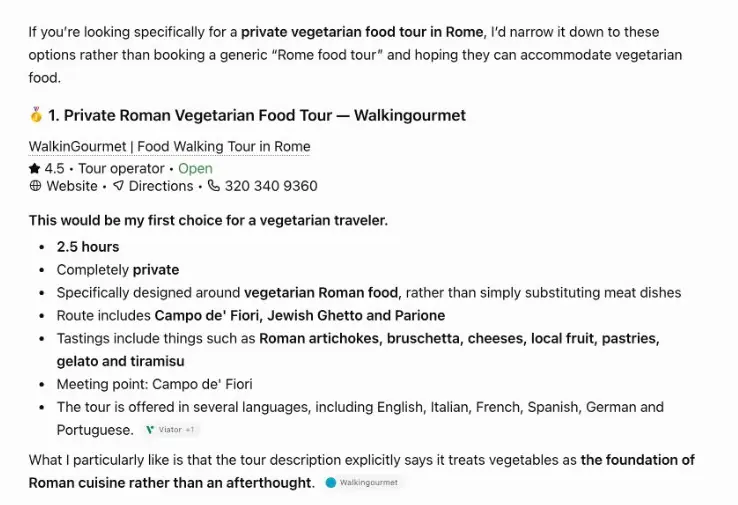
ChatGPT — this client named as the first recommendation, with the reason lifted straight from the tour page.
How it works
Fees, scope, and how we’d start
Step 1
We talk
Free, thirty minutes. You describe what’s happening; I tell you what it needs and whether that’s me. No charge, no pitch deck.
Step 2
You get a fixed quote
Written scope and a fixed fee, agreed before any work starts.
Step 3
You get something your team can ship
Two to three weeks. The audit, the fixes and the documentation are yours to keep.
The terms, in advance
- Fixed fees, from €1,500. Never hourly, never commission.
- Written scope. If it changes, it gets re-quoted — not absorbed.
- You keep everything — the audit, the corrected structured data, the documentation.
- Typical timeline: two to three weeks from kickoff.
Ongoing work
Most engagements start with a fixed-scope audit. If you want to keep going afterwards — monthly execution, keyword strategy, analysis, or a longer SEO programme — we scope and price that separately, on the same terms.
I publish this because it’s the part most consultants leave until the call. If any of it doesn’t work for you, better that we both know now.
References
What past clients say about working with me
She identified and resolved the problem much faster than I expected — methodical, and able to adapt to constraints. I appreciated the trust she inspired from the very first interaction.
Olivia Amos
Founder, Libella · LinkedIn ↗
Shiva is great! Professional and honest — driven by improving herself and her clients’ digital presence.
Charlotte McCrudden
Business Developer, Lexist Law Firm, Istanbul · LinkedIn ↗
Questions
The three questions I’m always asked
“Isn’t this just SEO with a new name?”
No, but it builds on it. Classic SEO is organised around Google’s crawler and Google’s index. AI visibility is about a different set of readers — ChatGPT, Claude, Perplexity and Google’s own AI Mode — which weigh structured data and entity clarity more heavily than classic search does. If your technical SEO is already solid, you’re not starting from zero. Parts of the industry call this AEO or GEO; I use “AI visibility” because it names the outcome rather than the acronym.
“Do I still need you if we already have an SEO agency?”
Often yes, and it usually works well. Agencies are built for breadth — content, campaigns, links, reporting. This is a narrow, deep piece of work that sits underneath all of that. I work alongside agencies more often than instead of them, and I’m comfortable being the specialist brought in for this part.
“How do you measure whether it worked?”
With a dated baseline. Real buyer-intent prompts run against each engine before the work starts, recorded with your competitors included, then re-run afterwards. Nothing invented, and no scores that only exist inside my own spreadsheet.
Contact
Tell me what’s happening with your site
If you recognised your business anywhere in this, send me a short note about what’s happening. If I’m not the right person for it, I’ll tell you, and point you somewhere better.
Hiring rather than buying? Here’s what I’m looking for →
Also available: web development and marketing consultancy.