

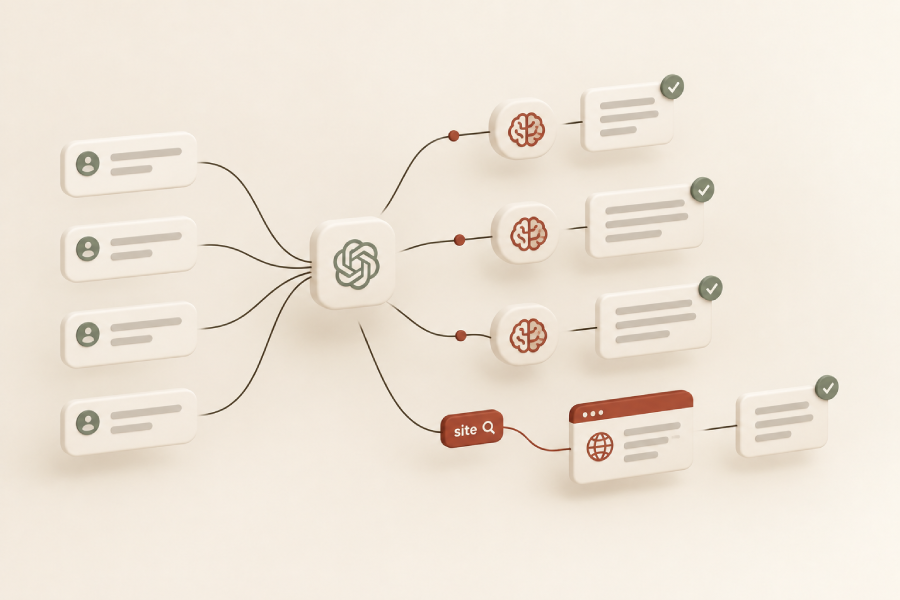
Sometimes — and far less often than three months of headlines have told you. Before ChatGPT answers a question, it runs a handful of background searches of its own, a step called query fan-out. Across the largest public sample, about 15 million of those searches, roughly 7% were scoped to a single named website (Ahrefs, October 2026). When I logged my own, none were. That gap is the whole story, and most of the advice being sold right now sits on the wrong side of it.
The short version:
- ChatGPT does not always search. Across 66.6 million answers, only 14.4% triggered any web search at all (Ahrefs, October 2026)
- When it does search, it runs about 1.6 searches per answer, and only a minority are scoped to one site with the
site:operator - The published
site:figures range from about 0% to about 90%, depending on the model, the surface and who did the measuring. There is no single number - In my own runs — 10 questions, read twice on different days — not one search used
site:. ChatGPT reached brand sites by naming the brand and adding the word “official” instead - The practical worry (“is ChatGPT crawling my site in real time, and must I optimise for it?”) is mostly misplaced. The mechanism is not what the headlines describe
The site: numbers, side by side — because there is no single one:
| Who measured | site: share of searches |
Setup |
|---|---|---|
| dejan.ai | about 0.1% | ChatGPT’s API, GPT-5.5 |
| Ahrefs | 6.8% | Free ChatGPT, GPT-5.6, 15 million queries |
| Promptwatch | 16.8% | ChatGPT app |
| Peec, Seer, DecaGEO | 43–90% | GPT-5.6, specific prompt panels |
| My own runs | 0% | Free ChatGPT app, about 40 searches |
What I did, so you can weigh it. I asked ChatGPT 10 ordinary questions — half short (“best password manager”), half longer and more detailed — and read the searches it wrote for itself in the browser’s developer tools, twice, on different days in September and October 2026. One account, the free plan, about 40 searches in all. That is small, and it is not an attempt to beat Ahrefs on scale. I ran it to watch the mechanism up close, and so you can repeat it on your own brand in two minutes, which is the last section of this piece.

site: anywhere (gpt-6-mini, 20 October 2026).What is query fan-out, and does ChatGPT always do it?
Query fan-out is the set of background searches ChatGPT writes and runs before it answers you, and it does not always run them. Across 66.6 million answers, only 14.4% triggered any web search at all (Ahrefs, October 2026); the rest were answered from the model’s own memory, with nothing live behind them. When it does search, it averages about 1.6 searches per answer.
In plain terms: you ask one question, and ChatGPT quietly turns it into a few of its own — rewording it, adding a year, naming products you never mentioned — then reads what comes back and writes the answer. The searches are the interesting part, because they are where it decides whose pages it even looks at. And on your own machine you can read them, which is what the last section of this piece shows you how to do.
This matters before anything else, because a large share of answers have no search behind them at all. If someone tells you their tool measured “how often ChatGPT searched your site”, ask what it recorded on the 85% of answers where ChatGPT searched nothing.

Does ChatGPT use the site: operator to search your website?
Sometimes, but far less than the headlines claim, and the honest figure depends entirely on the setup. The site: operator restricts a search to one named domain — site:yourbrand.com — and the published measurements of how often ChatGPT uses it do not agree with each other even slightly. They run from almost never to almost always.
- dejan.ai captured 196,692 of ChatGPT’s searches through its API and found
site:in 0.14% of them, with no jump at all on 8 August 2026 - Ahrefs, reading about 15 million searches from the free, logged-out ChatGPT, put it at 6.8%
- Promptwatch, sampling the ChatGPT app, reported 16.8%
- Panels from Peec, Seer and DecaGEO, run on the newer GPT-5.6 model with particular prompt sets, reported anywhere from 43% to 90%
Five measurements, the same operator, and a range from a rounding error to the overwhelming majority. When the spread is that wide, the number is not describing ChatGPT. It is describing the way each team asked.
Why do the published figures disagree so much?
Three things move the figure, and most coverage controls for none of them: the model version, the surface and the way the prompt is written. A test on the GPT-5.6 model behaves differently from one on GPT-5.5. A test through the API behaves differently from the same prompt typed into the app. And a short tracking-style prompt behaves differently from a long, natural question — dejan.ai’s own data suggests the prompt style, not the date, is what moves site: use.
So a headline that reads “ChatGPT now searches 43% of the time with site:” is really saying “on this model, on this surface, with these prompts, in this week”. Strip the qualifiers off and you have a number that sounds like a fact about ChatGPT and is actually a fact about a measurement. That is the distinction most of the coverage has lost.

If not site:, how does ChatGPT actually reach a brand’s own site?
It names the brand first and adds the word “official”, rather than scoping the search with site:. This was the clearest thing in my own runs, and it is the part the site: debate talks straight past. ChatGPT decides which brands belong in the answer before it searches, writes their names into its own queries, and points those queries at the brands’ own pages using plain words.
Here are the three searches ChatGPT wrote for one detailed password-manager question on the current gpt-6-mini model (20 October 2026):
Bitwarden Families pricing free plan sharing official 20261Password Families pricing features official 2026Apple Passwords app Android support sharing official
I named none of those brands. ChatGPT chose them before any result came back, and pointed one search at each brand’s own pages — with the word “official” doing the job people assume site: does. Not one of the three used site:.
That lines up with the scale data rather than contradicting it. Ahrefs found that among the most-searched site: domains, 75.9% were brand sites — apple.com, ikea.com, nike.com. ChatGPT does reach brands’ own pages. It just gets there more often by naming the brand than by the operator everyone is told to optimise for. Which makes the useful question not “how do I rank for site:” — there is nothing to optimise there — but “is my brand one of the names ChatGPT already writes into its searches, and is my official page readable when it arrives?”
Is this the same as ChatGPT crawling or indexing your site?
No, and conflating the two is the most common mistake in this whole topic. Three different mechanisms get blurred into one: training, retrieval and Google’s index. Being in a model’s training data is not the same as being fetched at answer time, and neither is the same as being in Google’s search index. ChatGPT runs its own crawler and its own retrieval, separate from Google’s, so a change at Google does not automatically touch it.
When ChatGPT runs a fan-out search and reads a page, that is retrieval at answer time — a live fetch while it writes the reply, not a permanent addition to the model’s memory. You cannot “add your site to ChatGPT’s knowledge”. You can make your pages legible enough to be fetched and quoted at the moment a search runs. And the word for what happens when it quotes you is cited, not ranked: there is no exposed ranking index inside an answer, only the sources the model chose to lean on.
Claude and Google’s AI Mode are separate systems again, with their own crawlers and their own retrieval, and nothing in this piece was tested on them. Where the published data touches them they behave differently from ChatGPT — which is the point: “AI search” is not one system with one set of rules.

What this does and doesn’t tell you
My runs are small on purpose, and the limits are part of using them honestly.
- One account, one location, the free plan, about 40 searches. This is a close look at the mechanism, not a population estimate. Ahrefs’ 15 million searches are the number to cite for scale; mine are the number to cite for what the searches actually looked like
- The numbers move, and OpenAI does not announce when. My runs on 23 September, 5 October and 20 October did not even use the same model each time — the free plan served the full GPT-5.6 early in the day and a smaller one later, and by the afternoon of 20 October it had switched again, mid-session and unannounced, to a new model,
gpt-6-mini. Any figure here carries its date for that reason - A
site:search shows what ChatGPT looked up, not what it cited. Looking at a page and quoting it are different events, and this test reads the first - Location leaks in. Asked a bare question with no country, ChatGPT sometimes assumed one and sometimes inferred a different one from the wording. If you test your own brand, that will colour the answer
None of that unsettles the core finding, because the finding is the agreement between a huge sample and a hand-read one: on the consumer version of ChatGPT, site: is rare and the brand-name route is common. It is a reason to be precise about dates and scope, which is the opposite of what the headline numbers have been.
How do you check whether ChatGPT searches your own site? (in two minutes)
Open the developer tools in your browser, ask ChatGPT your category question, and read the searches it writes for itself. You do not need a tool or a subscription, and it is the one check that tells you something specific to your brand rather than an average of someone else’s.
- Open ChatGPT in Chrome, signed out or in a private window, and open the browser’s developer tools (right-click, then Inspect), then the Network tab
- Ask the question a customer would ask — “best [your category]”, or a detailed version of it — and let the answer finish
- In the Network tab, filter for
conversationand open the response. Search it for the wordqueries - Read the searches ChatGPT wrote. Look for three things: is your brand named in them at all, do any use
site:or the word “official”, and whose domains do they point at
If your brand is in those searches, you are in the set ChatGPT considers before it even looks at the web, and the work is making your official page readable. If your brand never appears across five runs, no amount of site: optimisation will help — that is a different problem, and it is about being named and reviewed across the web, not about your own markup. Measuring whether you are actually cited once you are in the running is a separate exercise, which I covered in how to measure whether AI actually cites your business.
Your questions, answered
Does ChatGPT visit my website in real time when it answers?
Only sometimes, and only when it runs a search. Most answers have no live fetch behind them — across 66.6 million answers, 14.4% triggered any search at all (Ahrefs, October 2026). When ChatGPT does search and your page is relevant, it fetches the page live while writing the reply. That is retrieval at answer time, not a permanent addition to the model, and it is not the same as Google crawling your site.
Should I optimise for the site: operator?
No, because there is nothing there to optimise. site: is a search ChatGPT constructs; your site cannot make it more or less likely, and on the consumer version it is rare anyway — about 7% of searches in the largest sample, and 0% across my own. The thing worth doing is making the content a site: or “official” search would land on — prices, specifications, plain answers — readable as text on your own pages, rather than locked inside images or loaded by script.
Did ChatGPT really change how it searches on 8 August 2026?
Something changed, but the “it now searches your site directly” story overran the evidence. One tracker (Promptwatch) recorded site: use jumping that day; another (dejan.ai) recorded no change at all on the same date. Reddit’s share of ChatGPT citations did fall sharply in mid-August, which is what set off the alarm, and the cause of that was never settled — a change in how ChatGPT searches, a robots.txt block by Reddit, or both. A careful answer holds all of that at arm’s length rather than picking the most dramatic version.
Does blocking GPTBot stop ChatGPT searching my site?
Blocking the training crawler and being fetched at answer time are two different things, so blocking GPTBot does not do what people expect and can cost you citations. This is the same mistake as the site: one, made in reverse — treating one mechanism as though it were another. A fuller answer belongs in its own piece, but the short version is: do not block the thing you want to be read by.
Is this the same for Claude and Google’s AI Mode?
No. Claude and Google’s AI Mode run their own crawlers, retrieval and models, and the figures and behaviour in this piece are ChatGPT’s alone. Where published data touches the other two they differ — Google’s AI surfaces, for instance, declined gradually over the same period rather than shifting overnight. Treating the three as one system is the error the accuracy-minded version of this topic exists to correct.
The short of it
ChatGPT does sometimes search your website directly before it answers — but far less often than the last three months of coverage has claimed, and usually by a route nobody is selling you. The published site: figures run from about 0% to about 90% because each one measures a different model, surface and prompt style, and a number that moves that much is describing the measurement, not ChatGPT. Read at scale, site: sits near 7%; read by hand, I never saw it once. What I saw instead was ChatGPT naming the brands first and sending “official” searches at their own pages — which makes being one of those named brands, with a readable official page, the thing worth working on.
If you want to see it for yourself, the two-minute check above costs nothing. For the wider picture of how these engines find, read and cite a site in the first place, I set it out in how AI engines actually find, read and cite a website.